A language model that reads data row by row can answer differently each time, and can get a number wrong. A pipeline is code: the same data gives the same output, and every row is accounted for.
Aleria Fusion
Connect every system you run. Every figure keeps its source.
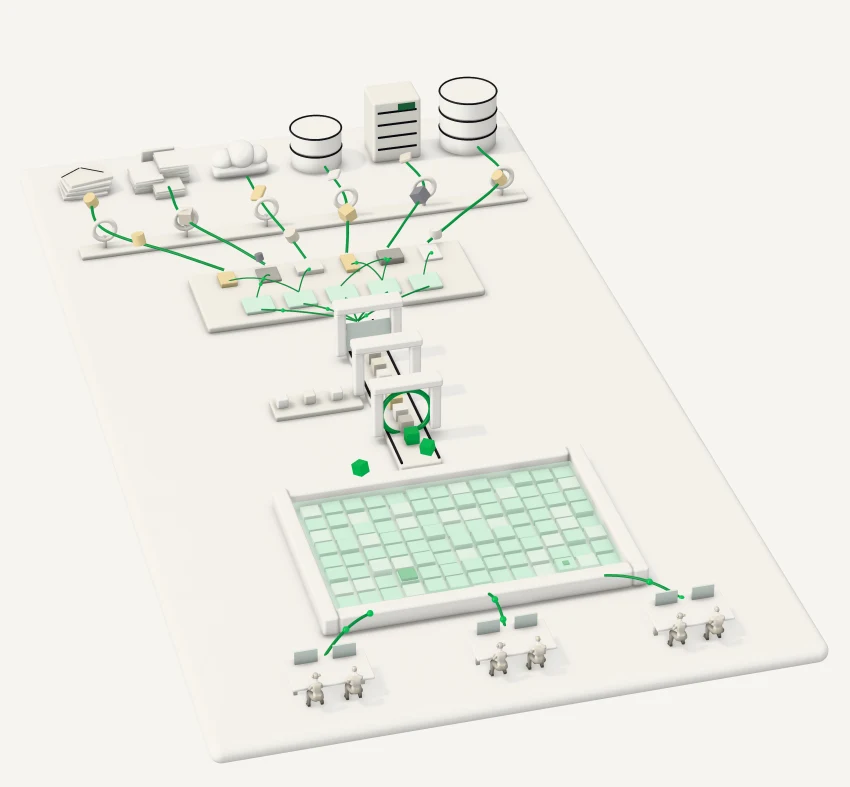
Aleria Fusion connects the systems your company already runs, from SAP and Oracle to databases older than your team. Their data lands in one governed datalake inside your environment, each record with its origin and its permissions.
- 400+
- systems it connects to, older ones included
- 96 s
- for a data job a traditional tool runs in nearly four hours
- No GPU
- to run a pipeline once an agent has built it
- 1 datalake
- inside your environment, with each person's permissions
An example
A finance director asks one question.
At 08:10 on Monday, Mariam, who runs finance for a group of companies, asks Aleria OS: “What were our operating costs in Q3, and what drove them?”
Overnight, Fusion has brought the ledger from Oracle, purchase orders from SAP and contracts from SharePoint into the datalake, and checked that the totals agree.
Each figure links to its ledger line. Asked about 2019, Aleria says the archive is not connected yet. A colleague in one subsidiary who asks the same sees only his own company's numbers.
Real estate · a case study
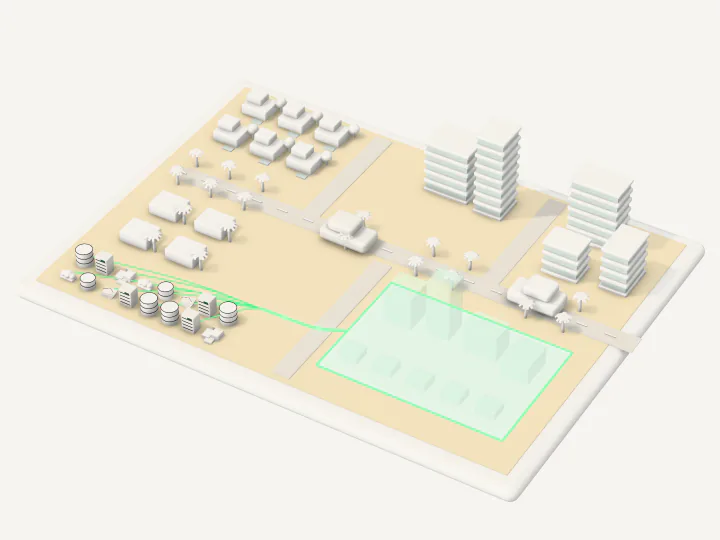
Feasibility studies that took months now run in real time.
One of the region's largest developers connected 16 enterprise sources, Salesforce, Oracle and SAP among them, into one view of every project.
Read the case studyFrom your systems to one datalake, in five steps.
- Connect
Fusion reaches each system through a connector Aleria builds itself, with no third-party software in between. Each connector reads with the permissions of the account it was given.
- Map
Fields from every system are matched to one schema, so a customer in SAP and the same customer in Salesforce become one record.
- Transform and check
Pipelines, the jobs that move and tidy the data, clean it, join it and check that totals agree. Your team builds them from about 400 ready blocks or in Python, R or JavaScript, or an agent builds them.
- Keep it in one place
The result lands in one governed datalake inside your environment. Each record keeps its origin and the permissions of the system it came from.
- Put it to work
Aleria's experts, chats and boards work from the datalake. Pipelines run on a schedule or around the clock, so the data is current when someone asks.
Speed
A data job that takes a traditional data-integration tool nearly four hours runs in 96 seconds on Fusion, on one machine, in Aleria's benchmark.
96 sagainst nearly 4 h
8×smaller files, nothing lost
Agents build the pipelines. Code runs them.
Ask for the data you need in plain words. An agent connects to the database, maps the fields to your request and checks their quality. It writes the transformations, generates the pipeline and runs it. When a run fails, it finds the cause, fixes it and runs it again, until the result is what you asked for. Then the data goes into the datalake.
The agent uses a model once, to write the pipeline. After that the pipeline runs as plain code on ordinary servers and spends no model time on your rows.
- ConnectPostgreSQL · finance_db · 214 tables
- Map38 fields matched to the request
- CheckDates in two formats · 312 duplicate rows
- Transform6 steps written · the pipeline generated
- Run 1Failed: a date in posted_at did not parse
- FixThe date step now reads both formats
- Run 22.1M rows · 0 rejected · 41 s
- DatalakeLoaded · runs every day at 02:00
What stays in your hands.
- Who sees what
- Each person sees only what they may open in the source system, and experts and boards inherit the same permissions. Fusion never gives anyone more access than the source system does.
- Where the data lives
- Inside your environment: hosted by Aleria in the UAE, in your data center, or air-gapped. It does not leave.
- What Aleria does with it
- It works on your request. Aleria does not take your data and does not train models on it.
- Which systems connect
- Your administrator connects systems one at a time. Each connector uses the account it was connected with, and only what that account may do.
- When pipelines run
- On a schedule, around the clock, or when someone starts them.
- How you would leave
- Your data stays in open formats, and the contract sets clear exit terms.
It connects to what you already run.
Databases, ERPs, CRMs, Microsoft 365, cloud storage, file shares and data formats. If a system has no ready connector, Aleria builds one.
- Oracle
- SAP
- Salesforce
- Microsoft Dynamics 365
- SharePoint
- Outlook
- PostgreSQL
- MySQL
- Microsoft Azure
- AWS
- ODBC
- FTP
- Excel
- CSV
- JSON
- XML
- Stata
- SPSS
- and 400+ more
Questions customers ask first.
Does our data leave our environment?
No. Fusion reads your systems where they are, and what its pipelines produce stays in a governed datalake inside your environment. Aleria does not train models on your data.
Do we have to replace any system?
No. Fusion works with the systems you have, older ones included, and changes none of them.
Who builds the pipelines?
Your data team, by dragging ready blocks into place or by writing Python, R or JavaScript, or an Aleria agent, from a request in plain words.
Does a language model touch our rows?
No. An agent uses a model to write and test the pipeline. The pipeline itself is code, and it moves every row the same way each time it runs.
How does an answer show its source?
Each figure in an answer links to the record it came from: the system, the table or document, and when it was read. If the data is not connected, Aleria says so and does not guess.
What happens when we connect a cloud service outside the country?
That service keeps processing your data on its own servers, under its own terms, as it does today. Fusion reads from it, and what Aleria produces stays inside your environment.
Can Fusion run on our servers?
Yes, with the rest of the stack, in your data center or air-gapped.